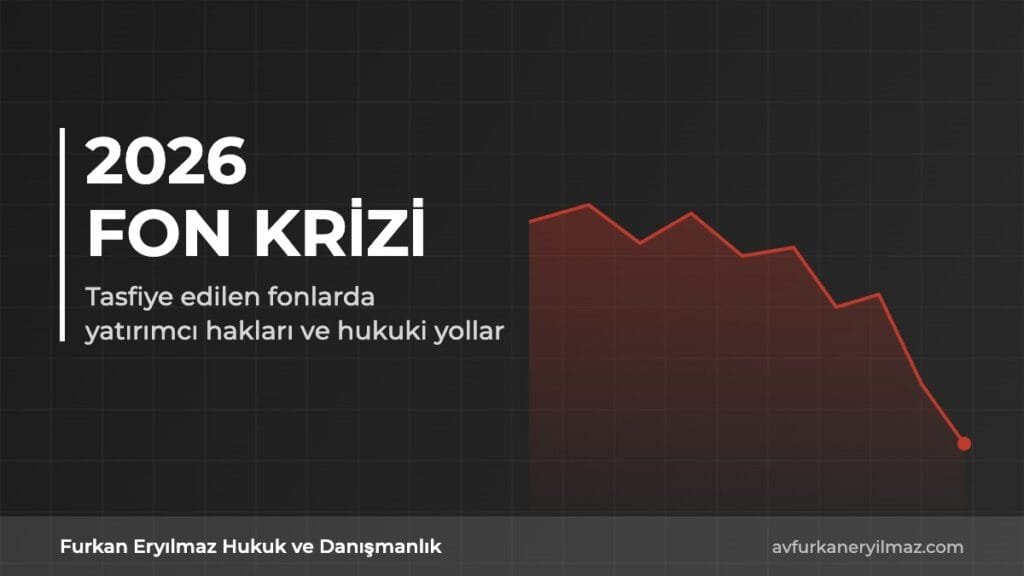
The Capital Markets Board’s (SPK) decision on 17 September 2026 to liquidate 131 investment funds belonging to seven portfolio management companies directly affected hundreds of thousands of investors. According to Central Registry Agency data, these funds have 455,758 investors. In this article, we summarise how the crisis developed, what Law No. 7596, which entered into force on 27 October 2026, introduced, and the legal remedies available to investors.
How Did the Fund Crisis Develop?
In the days before the liquidation decision, some portfolio management companies publicly announced that they could not meet redemption requests (default). According to allegations reported in the media, some funds artificially inflated prices in thinly traded shares and transferred fund resources to related parties. These allegations are being examined in a prosecutor’s investigation and have not been established by a court decision.
Key dates of the process:
- 17 September 2026: SPK decided to liquidate 131 funds belonging to seven portfolio management companies. Liquidation was assigned to public banks.
- End of September 2026: The liquidation period was extended from 3 to 6 months.
- October 2026: Ordinary liquidation was completed in some funds and payments were made to investors.
- 27 October 2026: Law No. 7596 on Certain Investment Funds Ordered to Be Liquidated was published in the Official Gazette.
What Does Law No. 7596 Introduce?
The Law applies to funds whose liquidation was ordered on 17 September 2026 and whose liquidation has not been completed. Its main provisions are:
- Net investment amount: The amounts each investor paid into and withdrew from the fund are calculated by the Central Registry Agency (MKK) to determine the "net investment amount".
- Interim payment: In funds designated by SPK, interim payments of up to TRY 1 million per fund may be made to investors, to the extent of the fund’s distributable cash. Interim payments are deducted from the final liquidation share.
- Blocked units: Investors whose TEFAS orders were not executed due to default and whose units were blocked are treated as unit holders in the liquidation.
- Recovery account: Assets transferred from the fund to related parties without an economic purpose may be recovered. Recovered amounts are collected in a separate account held at the Savings Deposit Insurance Fund (TMSF) for each fund and distributed only to that fund’s investors.
- Excluded persons: Persons whom SPK finds to have committed the offences in Articles 104, 106 or 107 of the Capital Markets Law, and those acting jointly with them, cannot benefit from these payments.
What Remedies Are Available to Investors?
1. Following the liquidation process: Liquidation payments are made through the assigned bank and MKK records. It is important to check that your net investment amount has been calculated correctly; if you believe there is an error, a written application can be made.
2. The prosecution process: While the investigation continues, investors who suffered losses can file complaints and request to join any public prosecution that may be brought. It should be noted that recovered assets are distributed not individually to investors but through the fund or the recovery account.
3. Action for damages: Law No. 7596 does not remove investors’ right to compensation. Where the loss results from unlawful acts, compensation may be claimed from the portfolio management company and other responsible persons. Amounts received from the liquidation are deducted from the loss.
4. Administrative courts: An action for annulment against SPK decisions, or a full remedy action based on deficient supervision, may arise. The time limit for filing administrative actions is, as a rule, 60 days and runs from notification of the act.
Keep Your Evidence Now
Whichever route you choose, documents will be decisive. We recommend keeping the following together:
- Fund purchase and sale receipts, bank and brokerage statements
- TEFAS order records and blocking notices
- The prospectus, key investor information form and promotional materials provided to you
- Your correspondence with the bank or brokerage and any guidance given to you
- Notices regarding payments made under the liquidation
Frequently Asked Questions
Is my money in an investment fund guaranteed by the state?
Investment funds are not deposits and are not covered by deposit insurance. However, liquidation does not mean that the money is entirely lost; the cash obtained by selling the fund’s assets is distributed to unit holders.
How can I find out whether my fund is on the list?
The list of liquidated funds has been published in SPK and Public Disclosure Platform (KAP) announcements. You can also obtain information from your bank or brokerage.
Should I hurry to file an action for damages?
Limitation and filing periods vary depending on the remedy pursued and the date the loss was discovered. We recommend obtaining professional legal support.
Result
The fund crisis is an ongoing process with liquidation, investigation and new legislation dimensions. Each investor’s situation differs depending on the investment date, the type of fund and the liquidation procedure. For a legal assessment of your fund investments, you can contact our office in Denizli.
Disclaimer
This article has been prepared solely for general information purposes on the basis of publicly available information and the legislation in force as of 12 November 2026. The statements in this article do not constitute legal opinion, investment advice or an offer to establish an attorney–client relationship. The processes, administrative decisions and legal regulations relating to the fund crisis are ongoing and may change after publication. Matters under investigation have not been established by a court decision, and the presumption of innocence applies to those concerned. Since each investor’s situation is unique, a legal assessment of the specific circumstances should be obtained before taking any action or pursuing any remedy based on this article. Furkan Eryılmaz Law and Consultancy cannot be held liable for any consequences arising from decisions made on the basis of the information in this article.